
- About Us
- Solutions
-
Products
Products
- Applications
-
News
News
-
Contact Us
Contact Us

Check out fresh news of Alphacell International.
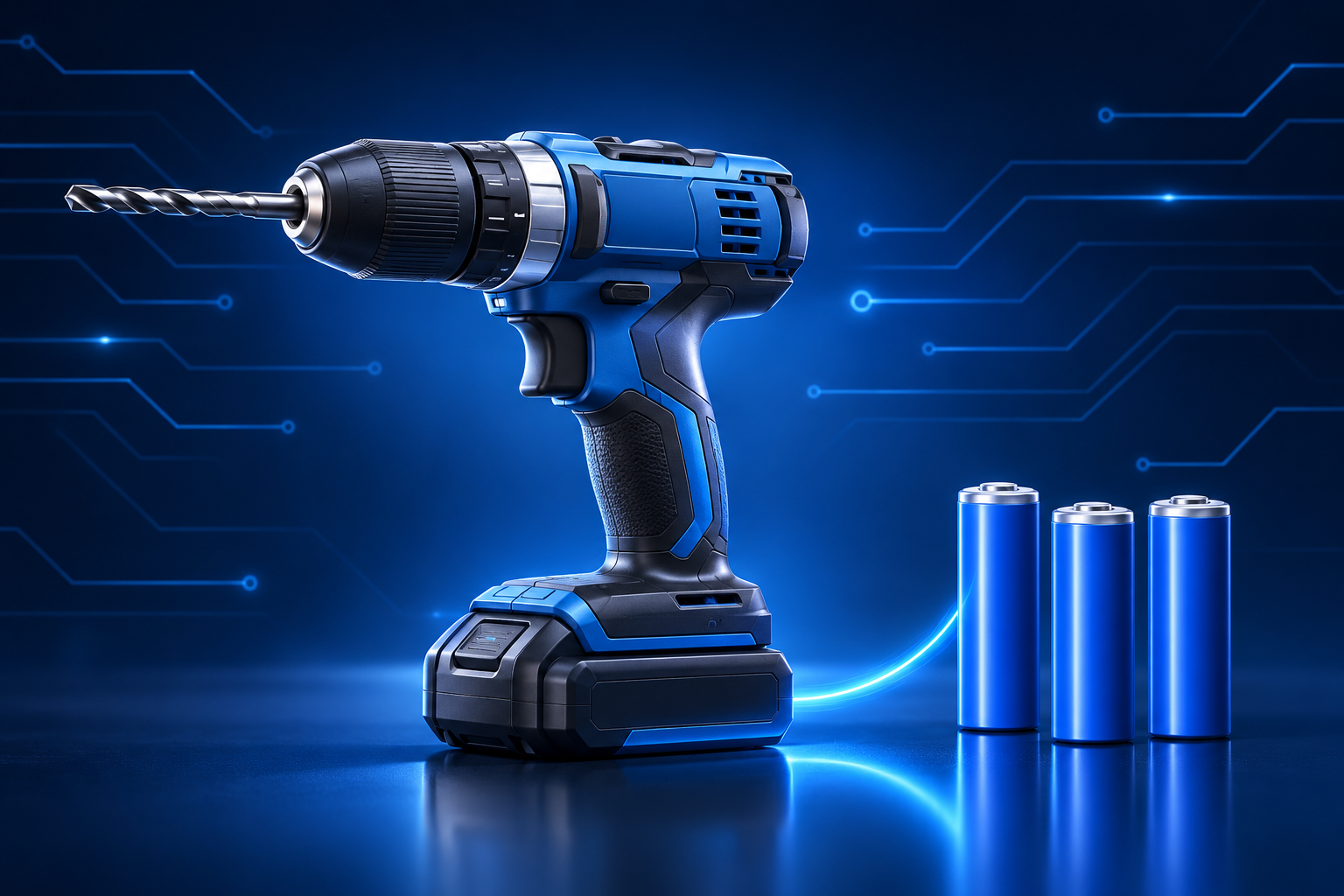
Cordless power tools such as drills, impact drivers, and grinders require high power output for short periods during operation.
Unlike batteries used in general electronic devices, power tool batteries must deliver high current reliably and maintain performance under repeated high-load conditions.
AlphaCell International Co., Ltd. reviews power tool battery pack development from the initial evaluation stage,
covering key aspects at each stage of development, including product requirement analysis,
cell selection, battery pack configuration and design, protection circuit evaluation, certification requirements, and production preparation.
In this article, we introduce the key technical characteristics, cell selection criteria and
design considerations involved in developing battery packs for cordless power tools.
1. Output Performance Is the Key to Power Tool Batteries
Power tools require high current for short periods during motor operation.
If the battery cells do not provide sufficient discharge performance, the voltage may drop significantly when a load is applied.
This voltage drop can reduce tool output or trigger the battery protection circuit, causing the tool to stop operating.
Therefore, when selecting cells for power tools,
it is important to consider not only rated capacity but also the following factors:
- Continuous Discharge Current: The current a cell can supply reliably over a specified period
- Peak Discharge Current: The short-duration current required during motor startup or high-load operation
- Internal Resistance: A factor affecting voltage drop and heat generation under load
- Discharge Characteristics: Voltage stability and available capacity under actual operating current conditions
In high-output power tools, cell discharge performance and internal resistance have a significant impact on product operating stability.
2. From 18650 to 21700: Changes in Cell Selection
18650 cylindrical cells have been widely used in power tool battery packs for many years.
More recently, the use of 21700 cells has also expanded.
Because 21700 cells are larger than 18650 cells, they can offer design advantages in terms of capacity and output per cell, depending on the specific model.
They can be used to increase pack capacity with the same number of cells or to optimize the battery pack configuration according to the required output and capacity.
However a larger cell does not necessarily provide higher output performance.
Actual performance depends on the discharge characteristics, internal resistance, and thermal properties of each cell model.
Therefore, the suitability of 18650 or 21700 cells should be evaluated based on the following conditions:
- Required output and operating time
- Battery pack installation space and dimensions
- Continuous and peak discharge performance of each cell
- Battery pack weight and mechanical structure
- Compatibility with the charger and existing products
3. Voltage Platforms and Battery Pack Configuration
Power tools use various voltage platforms depending on the product category, including 12V, 18V, and 36V systems.
The number of cells connected in series determines the pack voltage, while the number of parallel cells affects the overall capacity and current delivery capability.
Therefore, battery pack design requires careful evaluation of the series and parallel configuration based on the target voltage, required output, and operating time.
When multiple power tools share the same battery platform, the operating conditions of the tool with the highest load should also be considered.
For battery packs designed to be compatible with existing products, additional factors must be checked,
including mounting structure, terminal positions, communication methods, and charging conditions, as well as voltage compatibility.
4. Battery Pack Development: From Initial Evaluation to Production Preparation
Developing a battery pack for power tools involves more than simply selecting and assembling cells.
Product requirements and actual operating environments must be evaluated from the initial stage,
with the necessary technical considerations reviewed throughout each phase of development.
① Initial Requirement Evaluation
At the beginning of development, it is important to understand the intended application and operating conditions of the power tool.
Key items to evaluate include:
- Target voltage and required capacity
- Operating current under normal conditions and maximum load current
- Target operating time
- Battery pack installation space and dimensions
- Charging method and charging time
At this stage, AlphaCell organizes the requirements based on the actual load patterns encountered during tool operation.
This is important because selecting cells based solely on catalog ratings may lead to insufficient output or excessive heat generation during testing.
② Cell Selection and Battery Pack Configuration
Cell capacity, discharge performance, and internal resistance are compared according to the required output and operating time.
The series and parallel configuration is then determined, taking into account the battery pack's dimensions, weight, and installation requirements.
Comparing two or three candidate cell models rather than narrowing the selection to a single option from
the beginning can help balance performance requirements with supply conditions.
③ Protection Circuit and Thermal Management Evaluation
The key functions of the BMS and protection circuit must be evaluated according to the high-load operating environment.
Protection against overcharge, over-discharge, overcurrent, short circuits, and
abnormal temperature increases should be checked to ensure suitability for actual operating conditions.
Cell arrangement, spacing, and internal heat transfer paths should also be reviewed to prevent excessive heat from concentrating in specific areas of the battery pack.
Protection thresholds require careful adjustment.
If they are too loose, safety risks may arise; if they are too strict, the power tool may stop even during normal operation.
Finding the right balance under actual load conditions is therefore essential.
④ Certification and Safety Requirements
For products intended for distribution or use in the Korean market, applicable KC safety requirements should be reviewed from the early stages of development.
Whether KC certification applies and which test items are required may vary depending on the product type, structure, intended use, and scope of application.
It is therefore important to distinguish the certification scope of the battery pack from
that of the finished product and to identify the necessary test data and technical documentation in advance.
For international lithium battery transportation, relevant transport safety requirements, including UN 38.3 testing, must also be considered.
UN 38.3 is a transportation safety testing requirement and is separate from KC certification.
⑤ Production Preparation and Quality Evaluation
Before moving into production, the battery pack assembly structure, cell fixing conditions,
insulation, wiring layout, and connection stability should be reviewed.
Assembly and inspection conditions must also be evaluated for the intended production environment,
with key inspection items established to support consistent product quality.
Issues that do not appear in prototypes may emerge as variations during mass production.
This makes production preparation an important factor in determining final product quality.
5. Common Challenges Encountered During Development
During power tool battery pack development, issues that cannot always be predicted from cell specifications alone often become apparent during actual testing.
Tool Shutdown Under Maximum Load
When maximum load is applied, a sudden voltage drop may occur, causing the protection circuit to activate before the tool can continue operating.
In many cases, the issue is not necessarily caused by a defective cell but by a mismatch between the cell's discharge characteristics and
the protection circuit settings. Both factors need to be evaluated and adjusted together.
Temperature Rise in Cells at the Center of the Pack
In battery packs containing multiple cells,
cells located near the center may experience higher temperatures than those on the outside.
This issue often becomes apparent during continuous-operation testing.
Cell arrangement, spacing, and heat transfer paths should therefore be reviewed during the design stage.
Multiple Design Changes When Switching from 18650 to 21700 Cells
Changing the cell format affects more than just the cells themselves.
It may also require changes to the battery pack dimensions, cell holders, fixing structures, and charging conditions.
The scope of these changes can vary significantly depending on whether compatibility with existing products must be maintained.
Defining the scope of the conversion in advance is therefore essential for schedule management.
Addressing these challenges early in the development process can help reduce design changes and repeated testing.
Conclusion
Battery packs for cordless power tools must meet demanding requirements for both high power output and repeated high-load operation.
As a result, development challenges may arise that cannot be fully anticipated from cell specifications alone.
AlphaCell International Co., Ltd. supports the battery pack development process based on product operating conditions and required specifications,
covering initial evaluation, cell selection, battery pack configuration, safety requirement reviews, and production preparation.
For power tool battery pack development projects, suitable cells and battery pack configurations
can be evaluated based on key information such as required voltage, maximum load current, target operating time, and installation space.
Please feel free to contact us via Contact Us or support@alphacell.co.kr
Thank you.
#PowerToolBattery #CordlessPowerTools #HighOutputCells #21700 #18650 #BatteryPack #KCCertification #UN38.3 #AlphaCellInternational


 Google map


